
Chapter Seven - RECOVERING THE BALLOON
The morning after the rescue, Friday the 18th of January, the pilots, their relatives and the control, and camera crews left Yellowknife; Richard and Per for a press conference, the rest to get on with their lives. The five retrieve crew (John A, Keith G, Jo H, Alex R and Jules W) stayed behind to recover the balloon.
Their objectives were:
- — to locate the balloon and verify the landing position
- — to remove the envelope and salvage the crown, mouth and logos
- — to leave the wilderness as we found it, with no debris
- — to box and store all the components in Yellowknife ready for transport
THE BARRENLANDS
The balloon had landed 230 miles Northwest of Yellowknife, in a remote, desolate and uninhabited area of the vast Canadian Northwest Territories. The Territories are "beyond belief" as the brochures say, with an area of 1.3 million square miles — equivalent to the whole of Western Europe, but with a population of only 54,000, less than half that of the Isle of Wight! The balloon was lying on one of the myriad finger lakes gouged out by prehistoric glaciers in an area of subtundra woods, now in the grip of intense mid-winter cold, ice and snow. Extricating the equipment would be a major under- taking and Yellowknife was to be the operation base.
YELLOWKNIFE
Yellowknife lies on the North shore of the Great Slave Lake and is the capital of NWT with a popula- tion of 14,000, about the same as Oswestry on the English/Welsh border where the Pacific Flyer was built by Thunder and Colt. The old quarter with log cabins nestling around the shore dates from the thirties when gold was discovered here. The new town lies further inland and dates from the sixties when it became the Territorial capital and consists of tower blocks, government offices and shopping malls along with a splendid Northern Heritage Museum containing an aviation section. Gold is still the major industry, followed by aviation, government offices, trapping and, recently, tourism. Despite, and probably because of the extreme harshness of the climate, there is a lively "boomtown" atmosphere with a mixed population of Dogrib Indians, Inuit (Eskimos) and European descendants and a scattering of visitors from all around the world. Government officials, miners, bush pilots, trappers and hunters from out of town mix together. Social life is lively with the popular ''Gold Range Bar" having the second highest takings in Canada.
Yellowknife is a true frontier town where the gravel highway ends and the Barrens take over, stretching interminably away to the North, West and East. From here the only access to the wilderness beyond depends on the bush pilots and their rugged workhorse aircraft flying out of Yellowknife airport where we based the recovery operation.
BUSH AVIATION
Yellowknife is the hub of the far North transport system. The airport and bays and creeks around the town are littered with a fascinating variety of ski and float planes, many would be considered classics or relics elsewhere, but here in the isolated North they are still working hard for a living. Dakotas, Beavers and Twin Otters are firm favorites. From its early days the town was dependent on its air traffic. As far back as 1938 more air freight was carried between Edmonton and Yellowknife than in the entire United States.
The term "Bush Pilot" was coined in Canada to describe the rough and ready pilots who flew men, equipment and supplies to the remote mining, timber and trapping camps.
The Barrens provides an infinite number of landing places in the form of lakes and the planes are equipped with skis or floats to land on them. For brief periods in the "melt" or "Freeze" seasons the flights have to land on local strips or roads.
Our operation was a typical "bush flying" job, flying men and equipment to the landing site and finally "lifting" the capsule, tanks and envelope back to base.
To do the job we hired a Twin Otter Skiplane from Latham Island Airways and a heavy lift Bell 204 helicopter from Aero Arctic Helicopters.
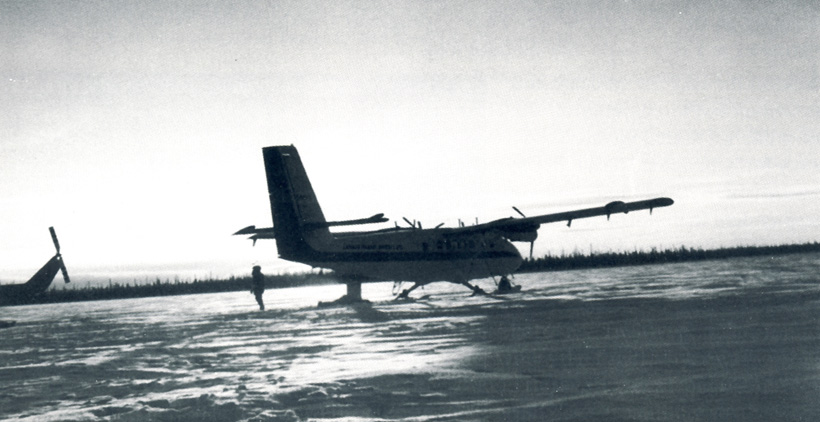
Bush Flying - Twin Otter Skiplane.
RECOVERING THE BALLOON
Still dazed with tiredness and jetlag, it was difficult to believe it had all happened. Richard and Per had flown the Pacific, been rescued and gone to L.A. We were still here, left to recover the remains of the balloon from a grid reference somewhere out there where the temperature was -32°C.
Bob O'Connor of Aero Arctic organized getting the team lotted out with Arctic combat clothing from the local military depot. Without it we could not have survived the six hours or so we were to spend out in the open each day.
With Jeff and Glen at the controls and the team in the back looking like a military raiding party, the Latham Island Twin Otter headed Northwest over a patchwork of lakes and woods. After one and a half hours (230 miles) we spotted the capsule lying on a lake — already nicknamed "Virgin Lake" with the envelope spiked on the pines along the shore. We circled around to photograph the site before we disturbed it, then put the skiplane down on the lake and verified the point of landing as 64 '25.14'N - 120'23.00'W on a typical frozen lake 40 miles South of Great Bear Lake, 140 miles South of the Arctic Circle and 130 miles East of the MacKenzie River.
The Barograph was removed from the capsule, still sealed, along with the camera equipment. 45 gallon fuel drums are a feature of bush flying and we unloaded 3 from the Otter and left them on the Lake to refuel Big Bob's heavy lift chopper which was to lift out the capsule.
On arrival back at the Latham Island hangar we were greeted by the local officer of "Indian and Northern Affairs" who informed us that we must remove all debris including the envelope from the wilderness, our intentions in any case.
The next day, Saturday the 19th, we were back in the Otter again loaded with two snowmobiles and trailer sleds, chainsaws and snowshoes. It was a beautiful still day with a low sun casting long shadows, even minus 32° seemed tolerable. What a pity that the balloon did not arrive on a day like this. The snowmobiles buzzed along the lake and up the shore carving a tortuous swathe between the trees up to the envelope which was well and truly "spiked" by the burnt out pines, forming a huge silver tent over the poles. What a tangle!
We eventually traced the crown ring and cut out Thunder and Colt and Virgin logos. Working in the deep snow was heavy going and the thick mitts could only come off for a few minutes at a time to do any fiddling jobs.
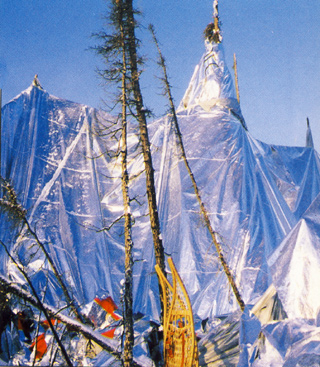
Back on the lake the valuable and delicate avionics were removed from the capsule while we waited for Big Bob in the heavy lift helicopter. Due at 10:00, it eventually arrived at 15:30 looking very resplendent in dramatic red finish with white Polar Bear logo. Kevlar straps were looped around the capsule load- frame. The helicopter took off in a flurry of snow and hovered over the capsule while we hooked up the dangling hawser to the straps in a raging, freezing rush of blinding snow that penetrated every chink in our clothing. We ran clear and the clattering throb of the chopper increased in crescendo as it hauled the 3,400 IN of capsule upright. By now, the daylight was too short to move the cap- sule so it was decided to see if the chop- per could lift the envelope free. We ventured back into the woods and once again stood in the numbing downdraft to hook up the hawser to the crown line. Up went the helicopter and we could see the strain go on the line. The helicopter piled on lift in a cacophany of noise and swirling snow, but the envelope did not budge an inch — it was well and truly stuck. There would have to be another way to get it out.
With daylight failing fast, we left the capsule, chopper, fuel, snowmobiles and the lake and headed back to base with our trophies. We had seen some photogenic stuff today! This was the world's most dramatic and expensive balloon retrieve and there was no film of it. We all agreed, the events had to be recorded, even if it meant a day's delay to organize a cameraman.
The next couple of days were lost to bad weather with freezing rain and strong winds out at Virgin Lake, but the time was used to organize a cameraman and details like maps, travel and thermal underwear. We also agreed to Bob O'Connor's proposal to hire a team of Dogrib Indians from Rae-Lakes Settle- ment, to camp on site and dismember the envelope with hunting knives.
Tuesday the 22nd was a beautiful clear day with no wind and only minus 24°C. As Latham's Otter was not available, we chartered one from Air Tindi down by the Old Town quay where a variety of ski and float plans were moored up to what would be a lakeside wharf in summer.
There we struggled to load a massive paraffin space heater needed to warm up the chopper that had been cold soaking for 2 days out at Virgin Lake. After that the 5 retrieve crew, 2 helicopter pilots, local reporter Rhona and cameraman Jeff squeezed on board. The pilots had difficulty unsticking the skiis despite the normal procedure of alternating full forward and reverse thrust on the props. The next technique was to bash hell out of the skiis with a handy FAA approved log. This worked and we got away for a beautiful flight up to Virgin Lake in the early morning sun, arriving at 11 a.m. The next 2112 hours were spent warming and fuelling the iced-up chopper out on the Lake.
In the meanwhile, the remaining fuel was burned off and heavy components, such as batteries stripped out of the capsule to lighten it. The capsule was then pushed over onto its side again, so the righting and lifting sequence could be filmed. The bright blue sky provided the perfect backdrop for Big Bob's bright red Bell when it finally lifted off in flying snow at 2 p.m. The capsule was hooked up to the dangled cable and the lifting straps guided clear of all the delicate equipment as the capsule rose, a freezing and intimidating task.
The capsule righted and lifted clear of the surface, hanging below the throbbing helicopter which was working hard to lift the weight, now registering 3,200 lb. (1450 Kg). With this load the chopper could only make 35 knots and the heavy fuel consumption limited its range down to 40 miles or less. It certainly could not make the Dogrib Settlement of the Rae-Lakes about 120 miles away, in one hop but would have to put down at staging lakes to refuel.
The Otter was quickly loaded with the great unwieldy heater and the mandatory 45 gallon drums before taking off to chase the capsule — too late to catch it and film it in flight. By the time we caught up it had already landed on a frozen lake awaiting the fuel from our drums. Another beautiful lake with the long Arctic shadows of the pines stretching like saw teeth across its pristine surface. The heavy drums were unloaded from the Otter and rolled across the snow and ice to refuel the chopper which took off on the next hop. Back with the drums, we were getting into the bush flying system. This time the Otter was close behind the flying crane and circled it in the dying sunlight filming against a typical Barrens background.
The second hop took us two-thirds of the way to Rae Lakes, a tiny Settlement of 200 Indians from which a wince road running over the frozen lake tops would enable us to truck the capsule back the remaining 225 road miles to Yellowknife.
During this leg of the journey we flew over an abundance of wildlife with moose in the woods, and great herds of caribou out on the lakes, with wolf packs hunting them. On landing at dusk on our next staging lake we narrowly missed a fleeing wolf — all recorded by our cameraman. The helicopter and underslung capsule put down shortly after us and with darkness and intense cold drawing in, we left the helicopter, capsule and obligatory fuel drums out on the lake with the wolves and caribou, and returned to the Old Town quay.
Early the following day we split up into groups to speed the recovery. The capsule group, Alex and Keith, was to fly with the Latham Otter out to the helicopter and capsule on the staging lake to refuel and warm the helicopter, then fly the heater and drums back to Rae Lakes to await the capsule. The envelope group, John and Jo, was to fly out to Rae Lakes in the "Tindi" Otter, collect a working party of "Natives" (as the Indians prefer to be called) and on to Virgin Lake to butcher the envelope.
Jules stayed in Yellowknife to organize packing and transport of the bits after we had collected them. The "envelope Otter" was met by a colorful reception at Rae Lakes, the work party riding out to meet us on their skidoos pulling sleds already piled high with supplies for the expedition.
The Otter was loaded to the roof with 2 skidoos, 2 long sleds, a stove, guns, snowshoes, tents, bed- ding and hunks of frozen caribou. The six Natives and us squeezed in and crawled forward over the equipment. It was so full, one of the Natives had to sit on a skidoo. We were revving up to take off for Virgin Lake when we got a message from the capsule Otter that it had turned back due to foul weather further North, and was heading for Rae Lakes to join us. Out we all crawled again and beat our way against a viciously cold wind, to the village hostel for warm coffee, where we were joined by the capsule team. While we were there waiting for the weather to improve, we heard Joe Black's tale, told in old Dogrib language and translated to us by Madeliene Chocolate. Maybe Joe was the only person to see the balloon in flight after the launch: before dawn Joe Black was riding out to the West beyond Rae Lakes to cut wood. He was amazed to see a light ahead of him stabbing at the sky. He stopped his snowmobile and the stabbling light came directly down towards him. His nerve finally broke, he switched off his headlight so he could not be seen and hurried back to the Settlement, in the gloom. He told his wife that a flying saucer was after him. He added that if he had known it was a balloon he would have stayed to see if he could help and asked if the pilots could remember seeing his snowmobile lamp?
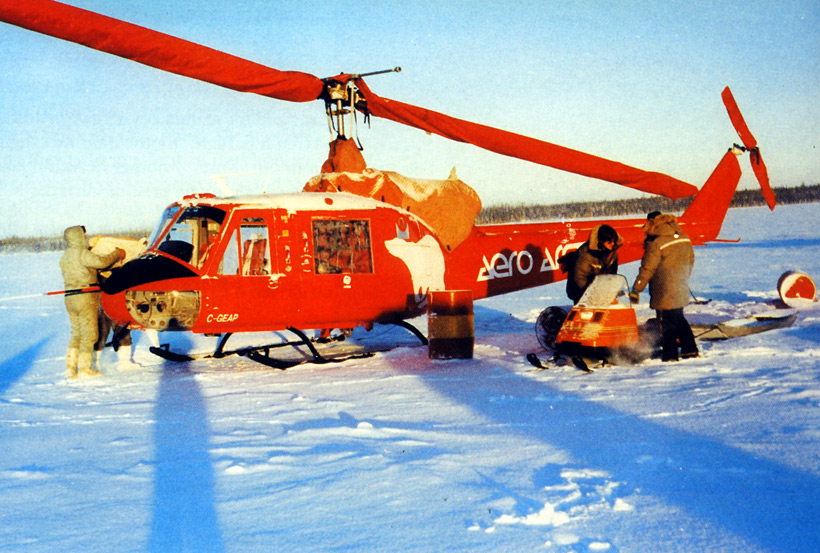
Heavy Lift Helicopter.
At mid-day the weather started to clear and by 13:00 we were crammed back in the Otter for another attempt to reach Virgin Lake. We flew down below the weather, literally down to 20 feet on the radar altimeter over some of the lakes, scattering caribou herds as we went. Flying with the Natives was like being in a cageful of cats surrounded by mice, as they excitedly pointed and craned their heads to see the fleeing caribou.
The Latham plane followed us as it was still too murky to fly the heavy lift, and landed first to film us coming in and disgorging the Natives and their paraphernalia.
The envelope gang soon got busy disembowelling the balloon, with hunting knives. The mouth, crown ring (scalp) and various logos were cut away and piled into the Otter. Meanwhile, the capsule crew tackled the tanks, bundling the 3 together with lifting straps ready for a quick pick-up when the heavy lift came for them.
With darkness drawing in, we departed leaving the Natives to set up camp and stay on site until they had sliced up the monster balloon bit by bit and bundled it up onto the lake ready to be airlifted out. The Otters headed back to Yellowknife over the weather at 12,000 feet.
Thursday the 24th was a mild minus 15°C. The Latham Otter headed straight for the capsule on the staging lake, with Bob O'Connor and the full team on board. Despite lugging the damn great heater out, the big Bell was started up without pre-warming due to the "mild" conditions. As soon as the gearbox oil was up to temperature the chopper hovered over the capsule and the three cornermen hitched her up to the skyhook, getting an unexpected joy ride before they jumped off and ran clear in the whipping snow. Bob and the big Bell made straight for Rae Lakes with the dangling capsule. An impressive Kenworth rig from Robinson's Trucking was waiting down on the lake ice and the cap- sule was lowered down onto the low loader trailer.
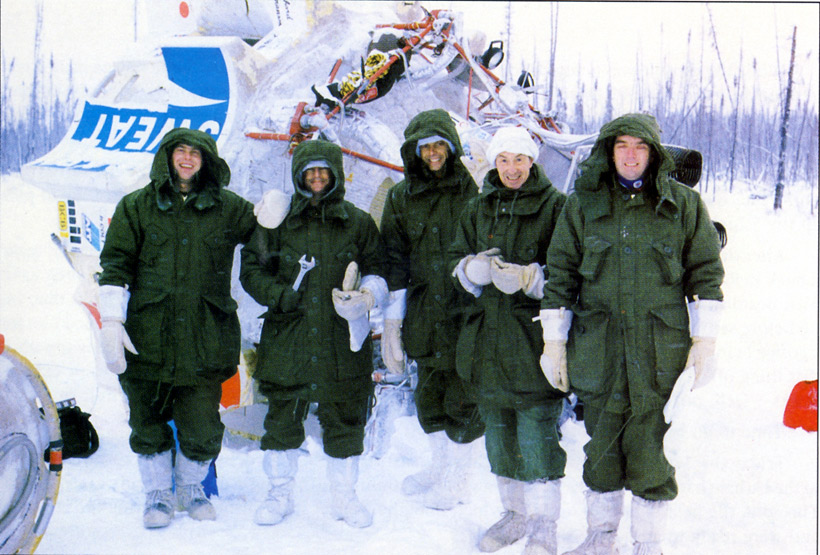
The Recovery Team.
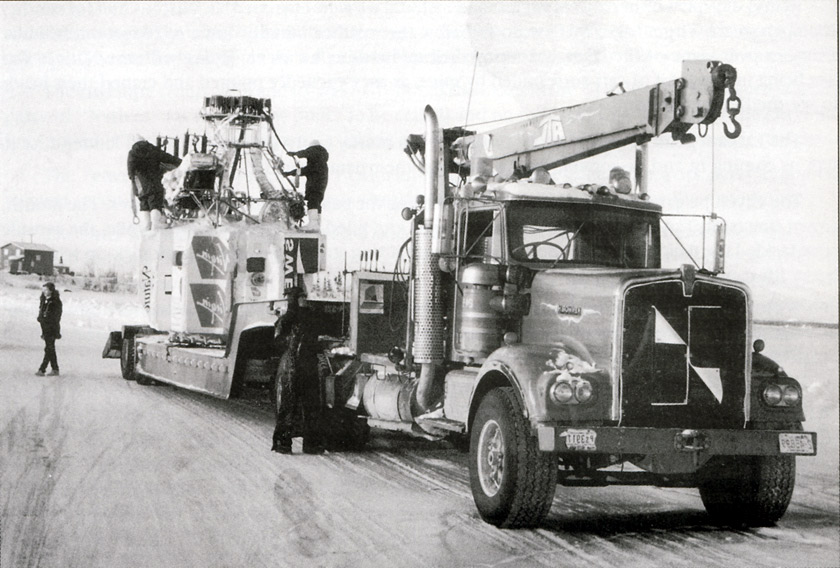
Truck and capsule on the ice road.
While the capsule was being lashed down, the chopper joined the Otter in the village main street to refuel from a dump of 8 drums that had been left there 3 or 4 months previously, but only 4 drums remained under the snow and two of those were empty — surprise, surprise! The shortfall was made up with diesel from the village truck, but the truck ran dry — surprise, surprise!
We had to wait for the truck to refuel, in order to refuel the helicopter. By now the sun as well as the fuel was getting low, so with no time to spare, the helicopter set out for Virgin Lake to pick up the 3 fuel tanks.
After delivering groceries to the Natives and refueling from the drums on the lake it could make it back to Rae Lakes with the tanks, in one hop, but by now it was the usual race against failing light. Alan Beamish, the truck driver, had to wait for the helicopter to return and load the tanks onto his rig before setting out on his all-night journey over the ice road to Yellowknife, so we joined him for a coffee before flying back ourselves. Alan left his truck running outside. "Aren't you going to switch that thing off" I asked, looking at the steaming vapor trails pouring from the great chrome exhaust stacks. "Hell, no" he said, "I don't turn that unit off until April, might never get it unfroze". Time to go before we got froze.
Friday the 25th - after driving all night across frozen lakes, Alan delivered the capsule and tanks to the Latham hangar where the team set about dismantling and boxing everything ready for transport. This took the next couple of days, by which time the Natives had finished butchering the envelope and were ready to go home.
Monday the 28th was to be our last day in Yellowknife. Jo went in the Twin Otter up to Virgin Lake to collect the Natives and return them to Rae Lakes along with the bulk of the material which was donated to the community where it will doubltess feature in covers, tents, decoration and souvenirs for years to come. The Natives had done an excellent job with the huge mass of fabric neatly packed and tied in bundles. The logos were sorted out and returned with Jo to the Latham hangar where they were boxed up as momentos for the relative sponsors in Japan, USA and England. Our Arctic kit was returned to the Army depot along with 4 crates of beer and tomorrow's flight tickets were collected. After twelve days, the Yellowknife episode was nearly over, and the team was sorry to be leaving this rough and ready, hospitable, hard living little outpost. We had already got used to the cold and the way of life, it would be strange to go back to the "ordinary world".
Tuesday the 29th - we returned to the ordinary world, and a 50°C temperature rise, in several hops. Flying via Edmonton, Vancourver and San Francisco and then driving on to the Red Lion Inn at San Jose and into the beds we didn't have time for on the 16th — that felt like five years ago.
Next Page


