
Chapter Five - A SECOND CHANCE
It was a beautiful morning as the helicopter flew south over the Shropshire hills. The bracken in the secret valleys was golden brown in the autumn sunshine. As we flew over the Long Mynd the ground rose up to meet us and the radar altimeter read less as we approached the summit, registering 200 feet as we passed over the top. A terrain following instrument like that could be a life saver if it came to landing the balloon at night or in poor visibility — another job to add to the list—one that was later to prove its worth.
It was late September 1990 and the funding had only just come through for a second shot at the Pacific crossing, but we were committed to be on-site ready to fly by the 3rd of December.
The first and most vital task was to get the new balloon envelope underway and hence the urgent flight down to Alpha International in Wimbourne to see their ultra modern material laminating plant. This time there must be no hang-up with the fabric. We were impressed by what we saw and wasted no time placing an order for them to laminate up 8 kilometers of material.
Just to make sure, a preliminary sample was produced and we put it through hell, freezing it, soak- ing it, crumpling it and warming it in turn — but no way could we get it to delaminate. We had no problems with the material from first to last and it was still in good shape when we cut it up to remove it after the flight.
Another urgent job was to overhaul the emergency equipment such as liferafts, parachutes and emergency location beacons.
Also, as we were proposing to fly in mid-winter, the chances of a night landing were increased, so we investigated flares and battery-powered lamps to illuminate the landing site. To test the effectiveness of these, night trials with a helicopter were arranged at Kidlington Aerodrome near Oxford and I drove down to witness the tests of the 28th of October.
A DRASTIC START
The A34 south towards Oxford was clogged with Friday evening traffic. In the distance the lights of a little two seat Schweizer helicopter flickered over Kidlington. Would I make it there in time to see the landing flares fired from the sinister looking barrels strapped to the chopper's landing frame? As I drove into the 'drome, a starburst lit up the sky and drifted slowly down on its parachute— I was just in the nick of time. The chopper throbbed its way around the perimeter and came in for another pass and another flare lit up the sky. The featureless field was bathed in soft yellow glow, but from the ground it was difficult to judge how effective the illumination would be from the air. The next test was to discharge a hand held flare from the cockpit door and see if this simpler device would project enough light to nightland the world's biggest hot air balloon at an unknown site after crossing the world's largest ocean.
The helicopter navigation lights swung around the far side of the field and its noise increased as it headed in at about 800 feet. "I don't like the idea of flares in a cockpit," said the voice of a bystander. "What if they go off inside?"
At that moment, the inside of the helicopter lit up with a bright yellow glow and the awful predic- tion was burned into our eyes as we stood transfixed, watching the deadly drama played out in the sky. The trapped flare should have been rocket propelled for a quarter of a kilometer before igniting the flare charge, which would float down to earth on its parachute. All this intense energy, heat, light and lethal smoke was now being violently discharged into the tiny bubble cockpit, full of delicate controls and electrics, and, most vulnerable of all, the two pilots. The scene in the cockpit must have been horrendous with pitch blackness outside and 80,000 candlepower blotting out all vision on the inside, and threatening to engulf the whole machine in flames. But still, the little craft clattered its way down under control.
In the background an alarm bell rang and brought us out of our transfixed trance — "grab a fire extinguisher!" Mary Ann, Per's secretary, fell into the car clutching one and we raced across the field to where the still glowing chopper had miraculously landed. I feared what we would find as we closed in behind the fire tender ... Per strolled into the headlights wearing his new red Thunder & Colt sweat- shirt and I stared as though it was an apparition, not daring to believe my eyes. "I think Mike's burnt his legs and hands a bit," said the apparition as the pilot pulled up his trouser legs to reveal pink scalded skin — but not serious burns — a small price to pay for stamping on the flames — and for being alive. What on earth happened? Apparently the pilot had intended to fire the flare out through the door but it had gone off inside the cockpit with the terrifying results we had just witnessed. "All hell let loose in the cockpit" as Per said. He had opened his door and leaned out to get clear of the smoke and then piloted the stricken chopped down into a pitch black field while the pilot stamped on the flames, making control even more difficult. The landing was heavy and broke the tail rotor, but it was a miraculous escape.
It was a drastic start to the 1990 attempt.
BACK TO JAPAN
Siberia seemed to stretch forever beneath the wings of the Virgin 747. Desolate plains with river meanders frozen into shining heiroglyphs in the early morning sun followed range after range of snow covered mountains for hour after hour—and this was small compared with the Pacific!
Preparations for the flight were completed as far as we could in the UK and now the advance crew were on their way to Japan to get the capsule out of mothballs and prepare a new launch site. It was November 20th and the balloon had to be ready for launching by December 3rd—two weeks to go and lots to do.
The journey took us across a humid and smoggy Tokyo and onto a transfer flight by crowded Jumbo down to Kagoshima in South Island, Kyushu.
There we were met by Jules who had organized our arrival and carted us off in a mini-bus to our base in Miyakonojo. This time, in deference to the winter season, the technical team were to stay in the Royal Hotel. Here we were introduced to our three translators — Yuko, Toko and Aiko — who were invaluable in helping us to get a million jobs done in a very foreign language.
During our absence of one year, the capsule had been stored in a tyre warehouse and a new launch site had been selected. On the morrow we would start to activate them both.
A NEW LAUNCH SITE
The 1989 launch site was not considered ideal in retrospect as it was prone to drainage air currents sinking down the hillside into which it was set, down to the flood-plain basin in which Miyakonojo is built. Early in the morning we could look down onto the inversion haze hanging over the plain, indicating the still conditions we needed.
Paul Head, our local Met man stayed behind in 1989 after the rest of the team went home, to research a new site. He came up with an area on the Eastern outskirts of town, in a field designed to be the campus for the New University under construction nearby. Apart from being calmer, the new site was a good 10 miles closer to America!
The launch pad was duly dug out of the baseball pitch and sunk into the new University site. Unfor- tunately, it was not the only thing to sink in, as the new field consisted of wonderful, soft, fertile, black volcanic silt that turned into a slippery bog after every rainfall. As we were perpetually transpor- ting equipment on and off-site something had to be done to prevent them getting bogged down. It was agreed with Aki that we would make a surround around the launch pad and form a causeway by dumping sand and rolling it into the soil.
Aki was our right-hand man. He ran a local construction company with access to materials, equip- ment, machinery and the men to operate them. He knew where to find things and who to contact to get any manner of unusual jobs done. On top of this he was a balloonist and an avid supporter of the project. Despite the language barrier, he was quick to appreciate our often strange requests and instant to act on them—and still keep smiling.
So the very next day the sand was delivered and duly rolled in. It was a beautiful warm dry day with a brisk wind and the micro fine mica sand particles blew off the surface in a mini sandstorm, quickly getting in everyone's eyes. How would our intricate capsule with its host of fine equipment and instrumentation stand up to this searching barrage? The answer was not good. Also, despite the sand, the heavy, small wheeled forklifts we used for loading the tanks, still got stuck — we had to come up with a better solution — Asphalt! So, a square of 20m by 20m of Asphalt was laid over the sand and around the landing pad. This was sufficient to keep the dust at bay and provide a good working area for the forklifts. At the Eastern edge of the field a double deck control hut was erected with the com- munications center on the top floor and the engineering support on the lower floor. Alongside the hut a Christmas tree mast was erected for the Icom communications network.
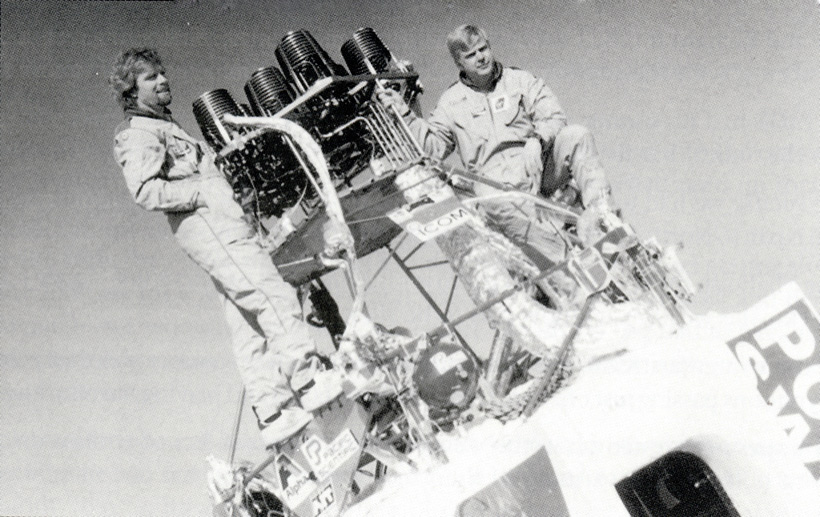
Richard and Per on the capsule.
PREPARING FOR THE OFF
A year's storage in the tyre warehouse appeared to have no detrimental effect on the capsule. Everything was as we had left it and only required re-assembly to get it back to scratch. We also had to incorporate the various improvements that had been decided upon, such as a radar altimeter and top deck fire extinguisher.
Boxes of parts were unpacked and the capsule moved onto the forecourt for work to start in earnest. However, we could only tackle the preliminaries as the final assembly of engine and burner stack had to wait until the capsule was on site, as they were too tall to pass beneath the mass of overhead cables criss-crossing the roads. Meanwhile, "lwatani", the local Propane Company, pressure checked the external fuel tanks prior to filling them.
While the capsule work was in full swing Keith Goffin decided to take a quick look at progress on the launch site. He found a convoy of sand lorries about to dump their loads onto the launch field and turn it into a mini Sahara complete with dust storms. We were just in time to stop our own private ecological disaster — a case of almost being drowned by the rescue boat. From then on the launch site became known as "the beach" and was the subject of much humorous banter among the crew.
On the 26th of November the capsule was trucked to the launch site and mounted onto its swivelling platform.
By the time the rest of the team arrived on the next day, the burners and engines had been mounted. With the full team on site, progress was rapid, the fuel tanks were tested and filled, capsule systems connected up and Icom radio communications mast erected and the control hut commissioned. A plastic ground sheet 80m x 50m on which to spread out the envelope, was ordered and Aki promised to organize 2 sideshift forklift trucks for tank loading on launch night.
The Project was running on schedule for the December 3rd deadline — but the weather was not.
WAITING FOR A WEATHER WINDOW
On November 28th Per and Richard arrived in Tokyo to give their first press conference. On the same day Typhoon PAGE arrived off the East of the Philippines—also headed for Southern Japan.
When Per and Richard reached the launch site the following day, they were greeted by torrential rain and high winds, with the capsule looking forlorn under its sodden and flapping cover.
Typhoon PAGE had no sooner run its course away to the North, when Typhoon OWEN started building up to the South, hardly the stable winter weather pattern normal for this time of year. To fly the Pacific we had to wait for a perfect weather window: a continuous, fast jetstream for 600 miles from Japan to North America, combined with perfectly calm stable conditions at ground level. Launching a balloon the size of the Pacific Flyer is a one-shot opportunity — once it is started there is no going back — the weather window had to be right.
This year the winter jetstreams did not materialize, but a late summer weather pattern persisted, with the two typhoons passing just offshore from Southern Japan and playing havoc with any plans to fly.
As all our hopes now rested on it, the weather became the subject of endless discussion. There was talk of ozone holes, global warming, el Nino and climate change, but one thing was constant, the long, highly technical weather faxes from Bob Rice always ended with a "red" (hold) status.
Every day Per and Richard held a Press brief at the launch site standing with a marked-up map of the Pacific behind them and every day the story was the same with variations on a theme. The high altitude jetstream aircurrents broke down in mid-Pacific or meandered off to the South or North or were too slow. December 3rd, our deadline date, came and went and the delay continued:
- December 4th—windy at launch site.
- December 5th—windy at launch site.
- December 6th—slow jetstream, track to mid-Canada.
- December 7th—slow jetstream, 70 knots, track curling to East off Hawaii.
- December 8th—slow jetstream, petering out mid-ocean.
- December 9th—long range forecast unsuitable until the 16th at earliest.
In the end, we started to get the impression that the press and audience did not believe, or could not understand the delay—everything else in Japan ran on time, why not us?
To make matters worse, Christmas was approaching and there would be difficulties getting airline seats for the team to return home, or chase the balloon across the Pacific. Perhaps we would do better to go home, get Christmas over and come back in the New Year when the weather had settled down. Meanwhile, the time was not wasted as work expanded to fill the time available. The capsule was checked and double checked and more refinements made, as we grew more and more familiar with operating the equipment. Per and Richard also had the opportunity of spending time in the capsule going over all the controls and contingencies, and generally getting the feel of what was to be their home for a long and lonely journey. In fact, we were in danger of over-servicing the capsule—it is difficult to get a team of enthusiastic engineers and electricians to known when to stop—perhaps we could just try ... ?!
By the llth the forecast was still bleak and that evening a decision was made — the Project would be put on ice until after Christmas. The crew would pack up and go home. The capsule would be stripped of sensitive equipment and a temporary building erected over it.
The envelope would be stored in a warehouse. A frantic packing session ensued as the crew had to vacate their rooms the following morning before going on to pack up the launch site. The next morn- ing the crew hurried to the breakfast room where Per and Richard were huddled over the latest weather fax. HOLD EVERYTHING! The computer was predicting a good track and weather window for the night of Tuesday the 18th—we could not let it slip.
All the previous arrangements were turned on their heads, hotels, airlines, etc.—God knows what the Japanese thought of it all?
Instead of packing our bags, we set about packing all the provisions into the capsule and waited to see what the weather would really do. By now, most of the press had used up their alloted time or patience and left anyway.
By Sunday the 16th, the optimistic forecast was deteriorating with the jet getting slower. On Mon- day the 17th the forecast for a Wednesday launch was RED — the jet was slow and deflecting down towards Baia Mexico — we wouldn't get a window before Christmas. We had to pack up and go back to the U.K. and return on the 8th of January when the world should be back to work and the winter weather pattern established.
The capsule was stripped of its delicate innards and Aki was left to organize a sectional building to protect it over the break. The team returned to the U.K. except Jo and Jules, who were left holding the fort.
1991 — NO MORE CHANCES
Tuesday, the 8th of January, 1991 — once again the ground crew is cacooned in the luxury of a Virgin Jumbo Jet and the Siberian wastes are unrolling beneath the wings, en route to Japan. This year we have to do it, or lose our credibility.
The long range weather forecast is looking good with a possible launch window for the weekend. The local weather is fine and work starts as soon as the team arrive. The hut is dismantled, the capsule re-equipped and the fule tanks refilled.
- Thursday the 10th -
- Friday the 11th -
- Saturday the 12th -
- Sunday the 13th -
- Per arrives on site. Weather forecast still looking good for Sunday the 15th/Monday the 16th.
The Japanese balloonist, Niwa Fumio, takes off at 4 a.m. in his helium gas balloon to attempt the first solo crossing of the Pacific. The envelope ruptured 300 miles out from the Japanese coast, but Niwa is spotted waving from his floating capsule. For unknown reasons, he is not picked up. Niwa's body is recovered by helicopter. He had died of exposure during the night. A sad and sobering day for us all. The envelope was collected from the warehouse and moved to the launch site in its container. Richard arrived on site.
Forecast looking good for Monday/Tuesday night launch, with phenomenally fast jetstream to California in 36 hours.
Final preparations and loading of the capsule. Men and machines are as ready as they will ever be — will Mother Nature let us do it?
Next Page


