
Chapter Six - ACROSS THE PACIFIC
BETWEEN WIND AND WAR
A quarter of the world away to the West, a major world event was about to unfold. The Gulf War crisis had been steadily building up for a showdown and the deadline for a peaceful solution was Tuesday the 15th — our first proposed launch date. If a shooting war started, our attempt would be eclipsed and Richard would need to be on hand with his Virgin Airline in case it was needed for air-lifting.
We had been on site since mid-November waiting for a weather window and now with the Gulf crisis deadline upon us, we were sandwiched between wind and war.
After 2 1/2 years of work and planning we had two days if we were lucky — it was launch now or never.
THE LAUNCH
The launch procedure was planned for a pre-dawn takeoff between 3:00 and 4:00 a.m. giving us the stillest part of the night for inflation and a full day of light ahead for the crucial early part of the flight.
Monday the 15th/Tuesday the 16th — The First Try
The jetstream was looking good with a fast 42 hour track and a slight northerly tendency towards Oregon. At the launch site it was a beautiful, sunny, calm day, our hopes were high and at 11:00 a.m., the launch procedure began by tilting the capsule into its launch position.
At 16:30 the big blue ground sheet was laid our ready for the envelope and as we spread it, a sudden gust lifted the edge — and behind the gust came a light Northwest breeze — suddenly the relaxed atmosphere became uneasy. Eyes glanced up at Paul Head's orange weather balloon tethered over the site — it was leaning well over in the breeze — but it was early yet. An evening breeze was quite normal and there was plenty of time for it to settle down, before 21:30 when the inflation was due to start. The envelope was uncoiled from the container like a huge snake, carried by a horde of willing Japanese spectators drawn from the crowd and directed by Tom Abe — T & C's agent in Japan. The silver envelope was laid out like an 80 meter sausage on the ground sheet ready for spreading, when the wind swung to the East. Once again the horde lifted the envelope and lined it up down wind and the capsule was swung round to suit. The envelope was spread out and the crew and assembled crowd waited, willing the wind to drop.
21:30 came and went and the orange weather balloon leaned one way and then the other as the hours ticked by.
At midnight the wind was still flukey, and at 01:00 a.m. on Wednesday morning, we had run out of time — we would have to pack up and try again the next night.
Tom rustled up another horde of disappointed spectators and the massive envelope was rolled up, tied and laboriously packed back into its container. The capsule was craned upright and covered against the forecast showers.
At 3:45 we were back where we had started 16 hours earlier.
The crew retired back to the Royal Hotel for a short sleep before starting the same process all over again later the same morning.
Tuesday the 15th/Wednesday the 16th — The Last Chance
The breakfast news was interesting:
- — it was deadline day in the Gulf crisis and war seemed inevitable and imminent.
- — Soviet troops had taken over in Lithuania.
- — It was Pacific Flyer's last chance before its flight permits expired and the war eclipsed it.
The jetstream prediction was for a fast 42/48 hour Pacific crossing, but with a Northerly swing towards Vancouver, followed by a Southerly drift once past the coast, bringing the balloon down behind the coastal ranges in Washington State.
The local forecast for the launch site was good. The day was fine and sunny, but with a steady Northeast wind.
Preparations for a launch got underway from late morning. The capsule was tilted and the ground sheet spread.
The wind persisted into the evening and erupting smoke from Mt. Sakurajima blew across the sunset, turning it a dramatic blood red.
All the signs of an inversion with its associated calm were there — a clear sky and a cold misty haze creeping into the valleys in the surrounding hills.
The local balloonists assured us the wind would drop — and it finally did — but not until gone 10:30 p.m. when apprehension was running high.
An hour later the air was still settled so the launch sequences went ahead. The envelope was dragged out by another army of 90 or so volunteers under Tom's directions and slowly emerged from the mouth of the container edging its way towards the capsule like a huge glistening centipede stalking its prey. Under the glare of the arclights the sparkling envelope was spread out and connected up to the capsule load frame via explosive bolt connections.
Just after midnight the cold inflation began — the balloon mouth was held open and the 4 inflation fans started up driving air into the cavernous void. The sudden noise and activity drove away any doubts — this was it! No going back now!
The envelope started to fill and the rigging crew climbed inside to begin the laborious job of checking and rigging the envelope. The parachute vent was located and the control lines threaded and wound onto the capsule winch drums.
One and a half cold and tense hours later the trio (Simon, Keith and Dave) had done their job — hot inflation could proceed.
Colston climbed in with the hand burner and fired up playing the heat around the envelope in bursts to circulate the hot air. Slowly and remorselessly the giant envelope filled and rose little by little. The warm air spilling from the mouth was a welcome relief for the frozen fan crews after hours in an icy draft.
The balloon rose with no rush or drama — a gap appeared beneath its flank and it gently floated up lifting the capsule upright with it. The capsule was hauled down and clamped to the load frame and the main burners took over — she was up!!
The great balloon stood majestically over the arena with the crowd gazing up in silent wonder at the huge silver monument, shimmering in the arclights — now they knew we really meant to fly! One could feel the awe of the assembled populance as the final stages of the launch were played out — a drama in which none of the actors could know the ending.
Moving like a disciplined team of robots, the crew forklifted the 6 massive 1 tonne external fuel tanks into place and connected them up. Meanwhile, the two engines were filled with oil and started, adding the howl of the compressors to the roar of the burners — the giant had come to life.
At 2:15 a.m. the mood of the crowd changed from awe to adulation — Richard Branson and Per Lindstrand had arrived! Richard circulated around the crowd of beaming citizens while Per did the final weather checks.
Balloon and crew were ready to go.
After the final press brief the two pilots walked over to the launch area, donned their parachutes and helmets and clambered into the throbbing capsule to take over the burners.
The burning now began in earnest and the balloon strained at its 6 tie-down cables. The loadcell readings climbed towards the 1.5 tonnes of lift needed for a clean getaway — this was it! After 2 1/2 years of work and waiting, Pacific Flyer was about to fly.
Would the 6 explosive cutters release her cleanly — or would the 6 "Kamikaze" crew have to dive between the great volatile tanks to cut her free?
Fire!!! — Simon Forse hit the switch at 3:47 a.m. She's away! The giant balloon had lifted effortlessly out of its cradle, unravelling its aerieals beneath it as it climbed vertically over the craning heads. This was really it, no going back now!! After all the months and hours of work and waiting, it was as easy as that — the flick of a switch and a perfect launch!
The balloon sailed serenely away, rapidly picking up the wind to the East and America. Higher and higher went the glow of the burners, no longer audible now.
The only communication from now onwards was through Paul Nicholson and Dennis Goodwin manning the Icom communications center in the launch site control room — all was going according to plan.
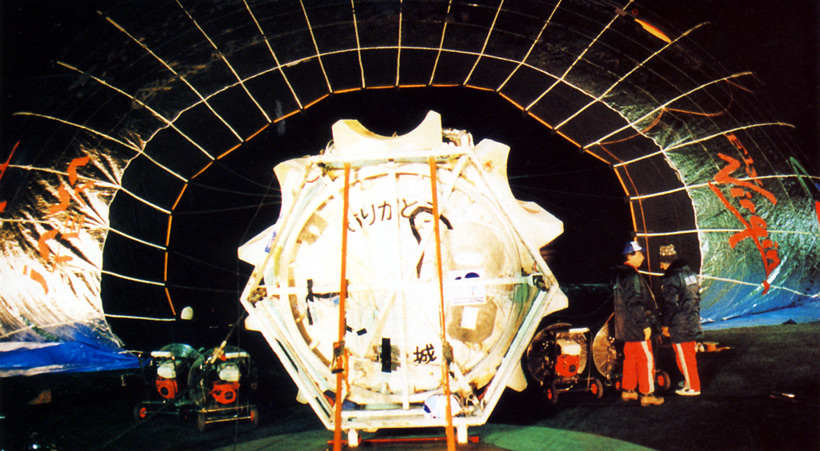
Cold inflation.
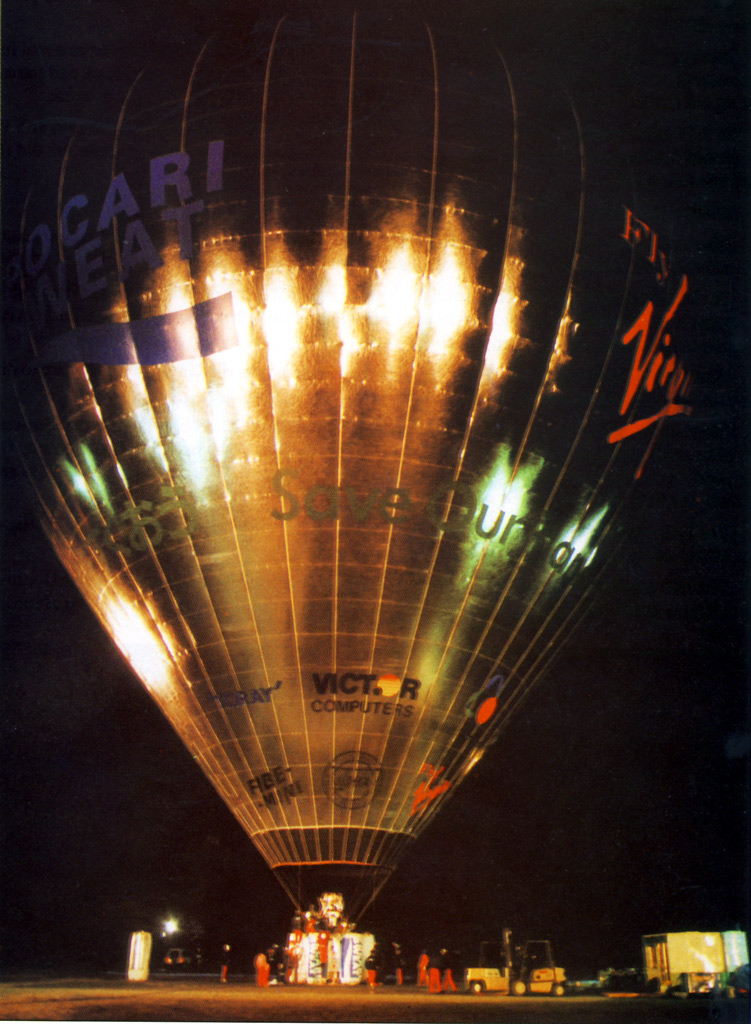
She's up - The Towering Balloon.
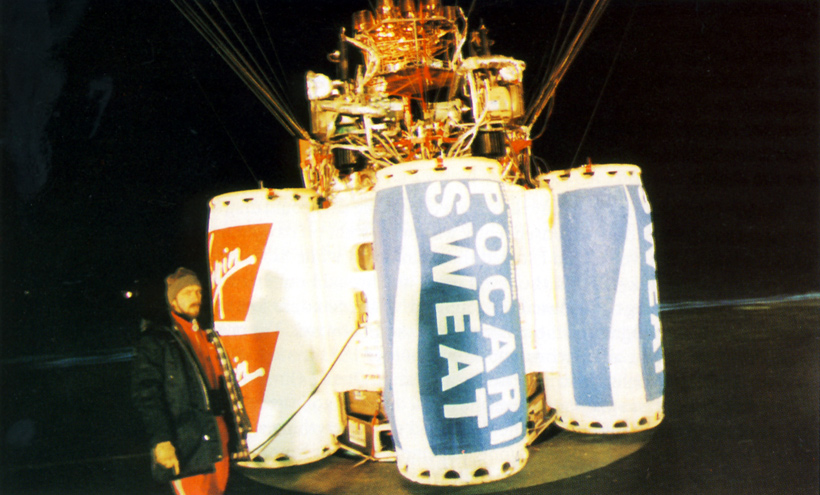
Pilots Aboard Capsule - Ready to Launch.
FLIGHT INTO HISTORY — PER'S STORY
The launch was perfect beyond belief. Particularly pleasing in contrast to all the delays and problems we had battled with in the last eighteen months. This winter we were originally out and on standby in Miyakonojo by December 3, 1990, but by December 17, with no weather in sight, we all went home with a promise to return in the New Year. In fact, there wasn't a single flyable weather pattern this winter until January 6. We all were back by January 8 and aimed for a Sunday, January 13 launch, but on Saturday morning it was quite clear the surface weather would block an inflation. By next day the jet looked good with a U.S. entry in Oregon and everything was laid out on the site. When, by one in the morning the wind was still blowing, we called it off. By Monday morning, the suface forecast looked perfect, the jet forecast acceptable, but with a promise of war the day after. All our flight permis- sions were only valid up to January 15, so this was our last chance. Richard and I went to bed early and were woken up at 1:00 a.m. (local) with the wonderful news that inflation had gone as planned and the balloon was snag free and ready to go. We were on site by 2:15 a.m. and after dealing with the media circus I spent an hour talking to Bob Rice and to the Thunder & Colt launch crew to check everything out. Simon Forse was the launch master and he gave me the shortest countdown I ever heard before he blew the six explosive bolts that held the capsule down to the launch platform. We had six load cells on the platform, so we knew all the time exact lift on the balloon.
Up into the night we went followed by the Fuji helicopter who stayed with us until I started pressurising the capsule at 8000 feet. Tokyo cleared us initially to 22,000 feet and soon thereafter to 27,000 feet, which was all we wanted to climb to this early into the flight, being heavy and in darkness. About three hours into the flight dawn met us and we were then well into the Pacific. The Tokyo Oceanic controller insisted we must fly out of his airspace through a fixed reporting point and nothing would make him change his mind. Our conversation contained shades of Black Adder, but I guess only one side was laughing.
At this point, life could not have been better. Finally, in the air after a year and a quarter of delays, but with a balloon humming away like it belonged to the sky. One thing which did surprise us early on was the distinct and nasty shear we experienced from the sub-tropical jetstream. Here you could have a 100 knot acceleration in a 500 feet vertical layer. The Atlantic was as smooth as a baby's bottom compared to this sonofabitch. We were thrown out of the jet quite a few times in a manner I have never been thrown out of any establishment before. However, we learned to live with it and after seven hours it was time to change fuel tanks. The first tank lasted as predicted and soon it was time to donate it to the sharks.
Tank jettison is always a slightly risky maneuvre as the tank could drag something with it or damage the capsule on its way down. Consequently we always went on oxygen masks and strapped in before firing the bolts. This we did and I started the countdown while Richard trained the outside cameras onto number four tank. I armed the firing panel and brought number four switch to firing position and a much louder bang than normal was followed by a tremendous jerk and the whole balloon behaved as if a giant hand had grabbed the crown and whisked it upwards. The rate of climb indicator bottomed out at 2000 fpm and the altimeter wound around but at a 15° tilt which from the pilot's position meant you were looking straight down into the stormy Pacific Ocean. Obviously something had gone wrong and my first thought was that the wrong tank (a full one) had gone by mistake. I undid my safety harness and stuck my head up into the acrylic dome and gave everything a good look. To my horror I saw that three rather than one tank had gone, the empty number four but also the full number two and number six, altogether 2.3 tonnes. No wonder the balloon had reared up, in fact, she would have been excused for tearing at this rate of climb, as she not only had to deal with excessive climb rate, but shearing through the jetstream at the same time.
At this point we told Flyer Launch (Miyakonojo) of the situation and everyone dived at their pocket calculators to work out remaining flight time. As we were still very early in the flight and had only yet flown in daylight, we had no real actual data to be accurate on fuel consumption, but had to work on our mathematical model. Simon Forse radioed back from Japan suggesting 35 hours remaining, which I more or less agreed with. The first real answer would come after the first night when we could extrapolate our fuel consumption. At this point our flight plan called for a 46 hour track into North America and we were ten hours into the flight, so it looked like a coastal landing somewhere around Vancouver Island. Looking down into the Pacific and seeing the white crests on the waves from 30,000 feet made us decide that there was no way we were going to ditch mid-Pacific.
We were now about halfway to the dateline and towards the end of HF range with Miyakonojo, but yet not able to raise Honolulu. This part of the Pacific is a bad sport for HF propagation but we were not unduly worried about it, particularly as we told Flyer Launch exactly this. Nevertheless, we did end up with a six hour radio silence, during which San Jose Control Center turned into San Jose Panic Center.
We had an agreed set of circumstances under which an emergency could be declared by the Control Center without radio contact with the balloon. It required either a position report from the Argos showing the same position twice (or nearly the same, indicating we were in the drink) or a satellite picking up our 243MHz ELT signal. Neither of those scenarios occurred, but probably due to the metallized envelope, the Argos unit only gave our position sporadically and thus the Control Center went into emergency mode.
When we re-established radio contract (through Honolulu Arinc) air traffic was quite happy with us, knowing well the HF propagation problems out there, however, our first phone patch with San Jose revealed they had a mid-Pacific ditching scenario worked out for us, complete with a C130 plus divers. Balls to that, that there was no way we were going into the sea until every drop of external fuel was consumed, or at least we were within range of a Coast Guard helicopter. What had developed in the Center was a story of its own and a classic way of how rumors are created, i.e., if you have no news—make it up. Suffice it to say two ships during our black out period actually saw us ditch in the Pacific. From here on we flew with one eye on the fuel gauges and of course with three tanks gone and much lighter, our propane consumption reduced drastically, but still, until next dawn, we were only guessing. Another problem with the unintentional tank release and the subsequent capsule tilt was the danger that the three remaining tanks could slip out of their sockets and thus expose their unprotected inside skin to the -47°C we had outside. This in turn would have cooled our propane to a level where it would not flow up into the burners. We had electrical tank heaters, but they were sized for fully insulated tanks. This caused us to crawl around the capsule rather carefully and every time we forgot and made a sudden movement we could hear the remaining tanks creaking in their sockets.
The first night came and never seemed to end. However, the best news was the speed of the jet that consistently kept above 150 knots and at the end of the night we saw over 200 knots sustained for almost two hours. This was very interesting as the forecast and the 300 mb chart never showed that kind of speed. We suddenly remembered Bob Rice's words that a balloon can go much faster than the charted jetstream speed. At the time I refused to believe him (the pilot's in-built skepticism about met forecasters in general), but he was right as usual. Hopefully our flight will generate more knowledge about the true character of the jetstream.
The unexpected speed increase was a great comfort as it meant we would reach the North American shoreline whatever happened, although we now had the weather for Vancouver which was 25 foot seas and southerly winds up to 40 knots.
One thing we almost totally forgot about was to eat. I think we had one or two apples each, a number of chocolate bars plus lots of fluids (Pocari Sweat naturally). We had no humidity control in the capsule so just like an airliner the relative humidity drops to about 20%. The only way to counter that is to drop the capsule temperature and we tried to keep it around 20°C. Temperature control was achieved by routing the air out of the supercharger either straight in or through an intercooler before reaching the capsule. The supercharger exit air was +165°C and the outside ambient air was between -30 and -47°C, so we had plenty of choice.
We spoke to quite a few airliners: there is a common chit-chat frequency (128.95) for pilot to pilot, and they all gave us their INS read-out for wind speed and direction which was highly useful to us in finding the peak speed of the jet. They all cheered us along and were a great comfort factor. However, the Pacific is a lot quieter than the Atlantic (and also much, much bigger), often there would be not one word on the airway frequency for up to half an hour.
Passing the dateline, which we did around midnight (local) was like the conquering of a great psychological barrier, as it also meant that we had broken our own Trans-Atlantic record from 1987 and we were halfway across the pond. We had only flown for 17.30 hours at this time against a forecast of 24 hours, so if we had had a bottle of bubbly on board we would have drunk it. Our average track speed since takeoff was 155 knots—most encouraging and well ahead on flight plan.
One weather problem we already knew of before takeoff was the split in the jetstream due to a building high pressure system over U.S.A. One branch went North into Vancouver and one South to Baja. Originally we expected the split at 155° West, but the High was building too fast and Bob decided to drop us earlier at 164° West as he was concerned that the southern branch would not quite reach the U.S. shore, but swing back to Hawaii. Being the good boys that we were, we left our friendly jet at 31,000 feet and went down to 18,000 feet to pick up a northerly airflow. By now it was daylight and unfortunately the cloud tops were right at 18,000 feet so we spent a lot of time in cloud, where we lost valuable solar energy. Once we hit 35:50 North, Bob felt we were out of danger and climbed us back into the jet which by now, as forecast, had lost a lot of its violent behavior, but also a bit of speed and for the rest of the flight we traveled between 110 and 150 knots.
Just as the sun set we had the nastiest moment of the flight. Richard was manning the burner controls while I was updating the flight log, when he suddenly screamed "We're on fire outside!"
At first I just wouldn't believe him, as nothing burns at 30,000 feet (it is hard enough to get a purpose- built burner working up there) but as I stuck my head into the dome my worst fears were realized, with one big blob of burning foam right next to the capsule dome and the high energy igniter box on fire. I tried frantically to figure out why, when I saw a large clump of ice crystals, obviously saturated in propane liquid, on fire dropping straight at me from the burner. It hit the protective wire mesh, which only made the burning pieces smaller and then they fell directly onto the top of the dome, still ablaze. What had happened was that the liquid fire nozzle had picked up a lot of ice crystals that partially blocked the jet, this sent raw propane spluttering onto the ice. When we hit wind shear the neighboring burner cross-ignited the ice/propane snowball and down it went, bit by bit.
My first reaction was to shut down the relevant burner, but then what? My nose was 5 cm away from the fire, but there was nothing I could do except tell Richard to make the balloon climb as fast as possible until the fire died of oxygen starvation, which it did at 36,000 feet. We did have a fire extinguisher outside, but it would have not just killed the fire, but also the burner and the two engines as well. Had the dome blown as I was standing there, with a capsule pressure differential of 8 psi, I would have been sucked straight up into the envelope by the decompression — not nice. After landing I immediately examined the dome and it did have a nasty burn mark right at the top.
We were now into our second night and were quite confident we wouldn't have any more frights, but little did we know. After a few hours of night flying our fuel consumption dropped down to 34 kg/hr and it was quite clear we not only would make landfall, but had enough to fly on inland. A long discussion with Bob followed over the radio, but he seemed a bit strained and concerned about our Vancouver track. At this point we were forecast to swing East, but the balloon continued right up into the Gulf of Alaska as if we were on line for Anchorage. Bob asked for an hour's respite to check for airline reports and consult his computer and came back to us about midnight with the bad news that there was no right in this track and that we could expect to continue on the present heading and make landfall somewhere near Juneau, Alaska, between 2 and 3 in the morning (local). By now I had run out of proper maps and had to make do with a coastal plotting chart where inland Canada was just one big white surface. Bob predicted our landing next midday near Yellowknife, Northwest Territories, but at this point I didn't even know where it was! Bob also predicted the jet speed to drop off, which it didn't, so at least we would be well clear of the Canadian Rockies before first light. It appeared that we would have tundra underneath us at dawn and we took the decision to land at first light. We knew there was at least 550 miles of Rockies before the tundra, but as we were still hitting 140 knots, we had no worries.
We crossed the Alaskan coast at 2:30 a.m. local and passed Juneau shortly thereafter, at 29,000 feet, while our three Learjet retrieve aeroplanes were refueling below us. They couldn't see us and vice versa, as the weather was appalling with 35 knots and driving rain on the coast. They were soon in the air and we discussed landing scenarios over the HF radio. Paul Woessner was leading the retrieve and had five of the T & C launch crew with him, plus my wife, Helene. The other Lears had a U.S. retrieve crew and media people, medics, etc. I concluded that the balloon was heading for Norman Wells and Paul got a forecast from Bob which looked good for landing at dawn. On the other radio, Anchorage Center handed me over to Edmonton, who sent me to Watson Lake Flight Service.
As always in frontier country, everyone is very helpful and Watson Lake gave me a detailed weather briefing where we heard of an approaching arctic storm expected to hit Norman Wells just before dawn with zero visibility and 35 knots blowing snow. Upon hearing this the three Lear jets diverted to Yellowknife, after radioing ahead and establishing there were helicopters for hire at the airfield. To be faced with this forecast at the eleventh hour of the flight was devastating and I looked over at Richard and asked him seriously if his famous luck had run out. Well, there was nothing we could do about it, as we were now over the Rockies with absolutely no chance of a night landing. Two gloomy faces in the dark racing at 140 knots straight into an arctic storm.
Our retrieve team was now on the ground at Yellowknife rustling up helicopters at 5:00 a.m. They could talk to us through Fort Simpson, who took on the role of co-ordinator for the landing. We talked to them originally on VHF, but as we flew on we had to go back to HE just as we cleared the Rockies in the dark, we received a message from our retrieve team to start a descent at 15.10 Zulu (8.10 local) for landing and we were given their estimate for where we would end up. This we did and left flight level 270 with a 500 fpm descent. Dawn comes late at these latitudes, 09.45 local in fact, and we entered the snow storm at 18,000 feet and were instantly surrounded by snow and ice crystals, which remained with us until we broke out at about 1,000 feet above ground level.
We knew from the forecast there would be a large wind shear at 5,000 feet so I leveled the balloon at 8,000 feet to complete landing preparations, just in case we had a descent below 5,000 feet that we could not arrest. The first thing to do was to stop the engines and shut down all unnecessary elec- trical consumers as we were now on battery power only. Then everything was stowed under the floor and strapped, so as not to become projectiles on impact. Lastly, we had to withdraw the locking pins that safeguarded against accidental operation of our envelope explosive bolts. This is traditionally Richard's job (he did it over Ireland last time) and with parachute on and hooked up to the lanyard, he crawled out through the top, as I had depressurized the capsule and removed the dome previously. It was still pitch black and snowing heavily, but the spotlights on the roof gave enough light to locate the pins. Richard handed them to me one by one through the top and I counted them finally twice. A forgotten pin would have been lethal, as the balloon would pull the capsule up and probably drop it before we reached an altitude from which we could parachute.
Once Richard was back in his seat I started the final descent at the same time as I received the message from Fort Simpson that our retrieve helicopters were late and the request that could we hold off for a while. Our answer was negative — once under the snowstorm we did not want to loiter, risking snow build up on the envelope, we needed to land as soon as practical. Besides, we would be traveling north by 30-40 knots away from the retrieve team. I gave Fort Simpson my last fix and shut all radios off, armed the Omega for groundspeed and started up my radar altimeter. We did not have an altimeter setting nor did I know the elevation of the tundra, so my primary instrument for landing was the radar altimeter. At 1,600 feet agl it scrambled into life as dawn was just about to break, I could now see the end of the crown line, but we were still in cloud.
At 1,000 feet we started seeing something that could be earth and Richard jumped up on top of the capsule because the three remaining fuel tanks were on my side of the capsule and blocked most of my view. I opened the side hatch a crack to see out and it was definitely earth down there. Richard insisted it was ice and I said it was trees. The argument continued for a while when suddenly we both realized they were definitely trees and they looked sharp, strong and hostile. We were now level at 500 feet and Richard shouted down he saw a lake in our flight path and I instantly (after seeing the trees) decided to go for the lake at whatever cost. I opened the parachute and initiated a rapid descent, while Richard kept describing the lake and when it looked like we would make it down on the lake I called him in to get strapped into his seat. I already had my 5-point harness on and my last action was divided between looking at the radar altimeter and cranking in the parachute.
When we hit the chute was almost fully in and the balloon was very Baggy. The impact was around 800 fpm, but we landed on three feet of snow with a very thickly foam-padded capsule. Two of our remaining three tanks tore off in the landing and disappeared underneath us, we tipped over and a rocket-sledge ride began. My last glance on the Omega before landing showed a ground speed of 30 knots and although our intention was to ride the envelope out on the parachute only, I blew the bolts within seconds of impact. What felt like two seconds translated into 100 yards and when the bolts went with a muffled bang, we stopped instantly and saw the envelope rise up a few hundred feet in the air and then empty completely before descending into the trees just over the edge of the lake, about 500 m downwind. A most spectacular sight.
Richard was out first with a speed I thought no human capable of and after shutting off fuel and electricity, I dived out after him to be met with -29°C and winds gusting up to 30 knots. Within minutes my hands were completely numb and I had to return to the capsule and rub them back to life.
I had seen cold climates before alright, but nothing like this — it was the high humidity and the wind that turned this part of the world into an ice age and we quickly dressed up into all the clothes we could find inside. At this point we expected the beat of helicopter blades any moment, little did we know we had landed 153 miles from the nearest road and 220 miles from the nearest town.
Our first task was to clear up the capsule, which was on its side with our bits and pieces everywhere. It is amazing how lost you can get in what was of great familiarity to us, after it is tilted 90 degrees. It took us almost an hour to get organized, not to mention dress up and of course prepare for an over- night situation if the weather outside got worse. Through the VHF radio we could hear a rescue plane (c/s Rescue 334) looking for us and we learned later he was a Canadian C130 out of Edmonton.
The C130 was overhead at 22,000 feet, just above the weather. He had a problem locking onto our ELT beacon signal and was thus imprecise in finding our location. I heard him declaring this on 126,7 to Fort Simpson, but due to the fact our VHF antennae were down in the snow and our hand held VHF was smashed, we couldn't transmit to him. At this moment we expected Woessy's helicopters any minute anyway, so we didn't bother to call him on HF. Little did we know that his helicopters had had to turn back due to appalling weather conditions. Finally, I heard the C130 (call sign Rescue 334) saying to Fort Simpson he couldn't find us, so I attacked the Icom HF radio and called Fort Simp- son on 5680 kHz who (to my great surprise) heard me strength 5, despite my aerial being buried in the snow behind the capsule. This was particularly pleasing as I had no inclination to go out in the blizzard and rig up a proper HF antenna. I gave Fort Simpson our position.
About one and a half hours had elapsed since the landing and although we had no worries about surviving a night on the ice, it is the last thing we wanted to do. We could now talk to the C130 directly on the same HF frequency and I suddenly realized that this frequency is common to the whole Northwest Territory and every bush operator seemed to be listening in on us. Thus, the Arctic Helicopter Co., where our retrieve team had returned after their aborted attempt to pick us up, heard my radio traffic with Fort Simpson and Rescue 334 and broke in. A few moments later I found myself talking to Helene on the HF with an unusual clarity, considering the conditions. I told her to call Oswestry and Richard asked her to call Joan, which she promised to do. We were now obviously relieved that the rest of the world knew we had landed safely, but we still had a pick-up problem and it was starting to get a bit chilly in the capsule.
It was only now that we first learned of what had happened to our retrieve helicopters: that all three had had to turn back to Yellowknife shortly after takeoff, due to appalling weather. Yellowknife was about 220 miles South of us and that is where the arctic storm was at its worst. Luckily there was a break in the weather to the Southwest, so Fort Simpson dispatched a helicopter (CF-FOM) on the 160 mile run up to our lake (now named officially Virgin Lake — it didn't have a name before). The C130 told us the helicopter would arrive at 1430 and suddenly I could feel the taste of brandy and cigars. The C130 decided to stay to guide the helicopter in (the helicopter could not home in on our beacon) and to get our exact location he needed a visual on us. He and I discussed the surface weather and he decided to have a go and left 22,000 feet. He was soon on the deck but with very poor visibility and was unable to locate us. He asked if we could hear him, which we could not, a throttled back C130 in a snowstorm is only audible within a mile, and we volunteer to fire flares when he ran into our position. After about five attempts he saw us and with hindsight it is quite obvious that the solitary capsule on the ice, being white, was almost concealed and the silver envelope in the trees blended in beautifully. He saw us before we saw him (and we saw him before we heard him).
It is a wonderful sight to see a four-engine plane like a C130 bearing down on you at tree-top level, particularly knowing that he has a cargo bay full of survival equipment which he can air drop to us. This he offered to do, but we declined, knowing that the helicopter was on its way. Rescue 334 kept circling us, giving us that desert island feeling, but we were now reassured that the helicopter would find us before dark. Naturally, once dark we would be stuck for the night as no one flies over these hostile areas after dusk. On the given hour we heard the noise of blades beating and a Bell 206 eased into our sights, trying out the surface a couple of times before settling down. Being a bush pilot, he started refueling his helicopter immediately, from 11 plastic drums he had carried inside his helicopter.
We had flown a track of 6761 miles at an average speed of 127 knots, over 46 hours and 6 minutes (all this to be verified by barographs, etc.) We had flown longer than any gas balloon or airship ever and if anyone had suggested to me beforehand that we may end up at a latitude 200 miles North of Anchorage, I would just have laughed. As a measure of how far north we were, it took us the next day, four and half hours with the Lear Jet to fly from Yellowknife to San Jose.
We had learned a tremendous amount about the behavior of the subtropical jetstream and when afterwards, sitting down with a calculator, I worked out that our Pacific balloon was 216% more fuel efficient than the Atlantic one—not bad progress in three years, considering that the longest a hot air balloon had flown prior to July, 1987 was 903 miles. When we landed we still had 24 hours of fuel remaining. We had dropped the equivalent of 27 hours in the Pacific and flown for 46 hours, i.e., 46 + 27 + 24 = 97 hours. Enough to cover at least two thirds of the earth's circumference.
PL: February 5, 1991CHASE INTO THE ARCTIC
Wednesday the 16th — The First
As the glow of the burners faded into the East, the launch crew retired to the control hut to release their feelings in a restrained and dazed fashion, forcing back the tiredness to discuss the finer points, or ponder over their own secret thoughts.
After the balloon had disappeared, the 5 man retrieve crew returned to the Royal Hotel to pack and prepare for the chase. They were John Ackroyd, Keith Goffin, Jo Hanson, Alex Ritchie and Jules Wigdor. At 08:45 they left the hotel and Miyakonojo for Kiroshima airport to fly on to Tokyo, Haneda, arriving at 12:30. From there a minibus took the retrieve crew, Richard's parents, David Spence, the ITN cameraman, and the last remaining pressmen on to Tokyo, Narita for their flight across the Pacific. From the bus the crew was in contact with the launch site through Will Whitehorn's mobile phone— batteries and tunnels permitting.
The first message was highly encouraging: the balloon was up to altitude at 27,000 feet and already a thousand miles to the East after only 8 hours; traveling at 164 knots, despite severe buffeting and wind shear trying to penetrate the jetstream core.
The next message to be relayed, however, was a nasty shock: on dropping the first tank No. 4, two additional full tanks, Nos. 3 and 6, had also plummeted down into the Pacific 5 miles below. One and half tonnes of fuel, 30% of the total, had been lost at the flick of a switch. To make matters worse, all 3 tanks were from the same side, giving the capsule an imbalance that tilted it at an unnerving 14 degrees.
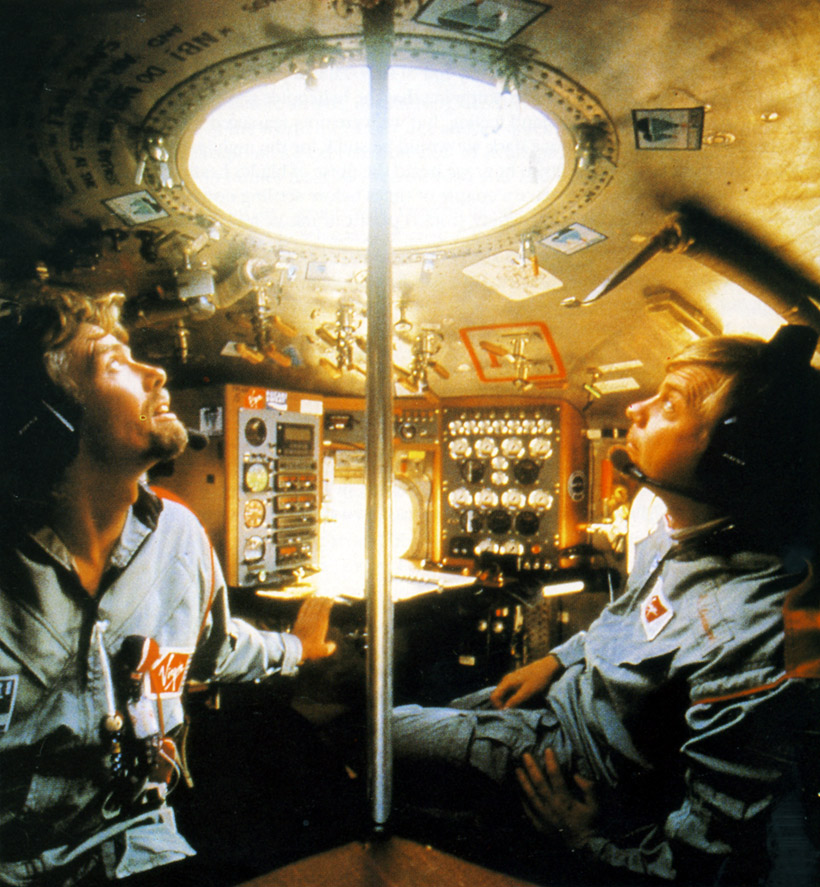
Per and Richard in Flight over the Pacific.
The sudden loss of the 3 tanks and fuel amounted to a total of 2 tonnes which made the balloon rocket up at a terrifying rate. The balloon was now 1500 miles out with 3 full tanks and the underfloor reserve, a total of 2000 Kg of fuel with 4,500 miles to go.
Wary of alarming the press or Richard's parents, Ted and Eve, we started making calculations of duration and range on the remaining fuel. The positive aspect was that the balloon was now much lighter and flying faster than we had ever dared to hope. It looked as though the balloon should reach the American coast, but we needed some night-time consumption figures before we could be sure. The only advice we could relay back to the pilots was: "Live with all the remaining tanks, don't fire them off as they empty—you could loose the lot"!
Whatever the idiosyncrasy of the firing circuit had caused the failure, we could not analyse now, that would have to wait until after the attempt. The next crucial decision would be whether to put down in the sea off Midway Island 3,000 miles out and hope to be rescued from the water, or push on into the next unbroken 3,000 mile leg to America.
At 4:00 the chase boarded a United Airlines 747 at Norita bound for San Francisco, from where they would join the control center team based in the Red Lion Inn, San Jose.
After boarding, I broke the news of the lost tanks to Richard's parents who had suspected something was up from our huddled conversations. Their trust in not pressing us for news until we could give them a considered view of the situation was much appreciated. The press were informed immediately afterwards.
Meanwhile, Jo went forward to the flight deck and told the crew about the balloon attempt that they would overtake during the night, and our role, and asked them to radio patch into Honolulu for position fixes if possible, to which they enthusiastically agreed. The Jumbo Jet took off and flew East into the foreshortened night and over the dateline back into the day it had just left.
Wednesday the 16th — The Second
The team ate their airline meal, and catnapped, until the breakfast call. Along with the breakfast came a note from the Captain with a fix on the balloon relayed from Honolulu-177W.32N.
19 hours into the flight and the balloon was over the dateline and so were we — it was the beginning of a second Wednesday the 16th. The balloon must be approaching its nearest point to Midway Island, halfway across the Pacific. By now the pilots would know their overnight fuel consumption and have made the decision to land in the sea or carry on. The next fix we received from the Captain at 6:34 a.m. Pacific time, gave us the answer Per and Richard were OK and flying high and fast - 20 hours flying and over half way. They had obviously decided there was speed enough and fuel enough to reach America and our spirits rose as we headed on for San Francisco.
Unknown to us, the San Jose control center had lost communication with the balloon for 7 hours in the night. During the long, lonely vigil with the balloon in mid ocean, two full tanks gone and no contact, spirits had sunk. Somehow news got out in the Press that the balloon had gone down in the Pacific — with the pilots blissfully unaware of the concern and conclusions. Fortunately, the facts were happier than the reports.
Fuel consumption during the night had been 44 Kg/hr and now with the solar gain of the daylight hours this should drop to almost nothing. With over 1000 Kg of fuel remaining, there should be enough to make it through the second night to the next morning.
About 24 hours and 3,700 miles into the flight, another crisis was reached. The weatherman at San Jose warned the crew that the jetstream ahead divided, with the upper level, where the balloon was flying, turning South and petering out East of Hawaii where the balloon would end up in the mid- East Pacific — not to be desired! The other, lower, stream headed Northeast towards Vancouver, not the best of landing areas, but definitely preferable to the mid-Pacific. To pick up the Northerly stream the balloon had to drop down to 18,000 feet before climbing again to 27,000 feet to regain speed. Per's longstanding quip of "Polar bears to the left, sharks to the right" had really come true! The balloon successfully picked up the Northerly jet and was heading for the polar bears.
Meanwhile, the United Airlines Jumbo Jet put down at San Francisco, at 10:00 local time. The retrieve crew hurried through the Airport facilities to be met by Graham from the control center, who drove us down South to the Red Lion Inn, San Jose, arriving at 11:30 local time. We checked in, dumped our bags and met in the operations room where we were joined by Helene, Per's wife. A large wall- mounted map of the Pacific showed the path of the balloon traced out with colored pins. The trajectory was to Vancouver Island and with the balloon traveling at almost 200 mph, there was no time to lose. The message was simple: grab a bag of warm clothes and tools, and go! We left everything else with untouched beds in the hotel rooms. Paul Woessner — control center manager—had two Lear jets stand- ing by at San Jose and the chase team split up 5 to each aircraft. Their destination, Seattle—nearest U.S. airfield to Vancouver.
The sleek, twin-engined business jets sat on the apron, bathing in the warm Californian sunshine. They were immaculately turned out and really looked the part with their high gloss finish, tip tanks and leather interiors. Still in short sleeves, the team piled into the little jets which roared off down the runway, climbed away like fighters and headed North up the dramatic West coast towards Seattle.
In the air, we received another fix on the balloon that put it 1200 nautical miles off the coast and traveling at 160 knots. The fuel reading was over 1000 Kg in 2 external tanks, even assuming the most pessimistic burn rate it should last to mid-day tomorrow — the 17th.
We arrived at Boeing Field, Seattle at 16:30 local time to set up the retrieve base in a local aviation center. The television set in the lobby was blaring out the news that war had been declared and air strikes made against Iraq. Despite the magnitude of events pouring out of "the box" and the fact that they would completely overshadow our efforts, we had no time for more than a glance — things were happening too fast.
Shortly after we arrived, we got a new fix which put the balloon's track over Queen Charlotte Island and 350 miles North of Seattle.
The flight had been going fast for 30 hours and covered 4000 miles, but now the crucial second night was drawing in. To the pilots and retrieve crew it promised to be an overcast, stormy and moonless night, full of uncertainty and tension.
Would the jet-stream stay fast enough to carry the balloon across the treacherous snow covered mountain ranges that extended for 600 miles inland, before the fuel ran out? Would the wind vere to the South as originally predicted, or would it continue to drive them even further North into the inaccessible Arctic wilderness where airfields and rescue services became more and more distant? Should they go for a sea landing off the coast and hope to be picked up from the stormy, cold, black sea by the Canadian coastguards, or should they risk overflying the mountains and hope to reach the plains beyond?
Messages concerning a possible sea landing passed between the balloon and retrieve crew, including weather and sea state, capsule preparations, activation of satellite beacons and search and rescue facilities. The nearest coastguard station was in Port Hardy in the North of Vancouver Island where a rescue helicopter equipped with winch, floats and paramedic divers was based.
The scenario was not a pleasant one, it was a pitch black mid-winter night, the coastline was rugged and desolate and the weather miserable with strong (40/45 knot) winds, rough seas and poor visibility, with periods of fog and driving sleet — a nightmare situation in which to land the balloon or recover the crew. Before landing, the crew would have to climb on deck to cut free and jettison the engines, to prevent the capsule from floating upside down and in the water — not an enviable task in the conditions. By 18:30 it was dark outside and the situation took on a dreamlike quality. Two all-night launch sessions followed by all the travelling and time changes combined with the everchanging news from the balloon and war front added to the unreal feeling.
The next fix from the balloon brought us sharply back to reality—the heading was even more Northerly: towards Sitka on the Alaskan coast — beyond range of the Port Hardy coastguards. We would have to fly North after the wayward balloon and move fast to catch it, even with the Lears.
The relentless high speed of the balloon now due to cross the coast at 1:30 a.m. put aside the question of a sea landing — Richard and Per would fly over the mountains and we would have to fly ahead of them. Helene, Per's wife, and Dave Spence, the cameraman, were recalled from the Hotel where they hoped to catch up on some sleep, the Learjets were refueled and we took off at 11:30 p.m. for Alaska, climbing up through the heavy cloud cover to break through at 28,000 feet.
We sped North in our luxury cylinder, each with our unspoken hopes and fears. Now in direct radio contact with Per, we plotted the course of the balloon as we converged on its track at 500 miles per hour. The good news was that the balloon should have plenty of fuel to fly for 800 miles over the mountains and arrive in the lakelands beyond in daylight. The bad news was that the lakelands were frozen, desolate, sub-tundra barrens with hundreds of miles between scattered outposts.
Our reception in Alaska was hostile. The first two airfields we hoped to put down at — Sitka and Ketchikan — were closed by drifting snow and 50 knot sidewinds, only Juneau, surrounded by glaciers and sheltered by mountainous off-shore islands, could take us. We came in low over the hill on the approach line and down onto the slippery runway in driving snow, to start a new day — January 17th.
Taxying the shiny California jets to the refuelling depot just after midnight we found it dark, deserted and desperately cold. We huddled in the entrance out of the driving snow while the pilots scurried off to raise some fuel. Half an hour later, a burly, cheerful Alaskan arrived to open up shop (Aviation Services, Inc.). Strong black coffee was brewed up in the cozy aviation center, while the Learjets were refueled.
We also took the opportunity to purchase charts of the area ahead, a luxury the balloon pilots did not have.
While refuelling was in progress the balloon crossed the coast just 15 miles to the South after 381/2 hours in flight. It was reassuring to hear Per's voice on the radio and know we were so close. The balloon was flying at 27,000 feet in heavy cloud and still traveling at 120 knots. The fact that it did not deviate nor land for fuel created a real tortoise and hare situation where we needed the speed of the Lears to get ahead of the speeding aeronauts.
At 3:30 the Lears took off from Juneau into inky blackness and climbed fast through the cloud. breaking cover at 28,000 feet. With the balloon flying below in the murk it was too dangerous to approach, so we flew ahead leaving the Alaskan coastal strip behind. Below lay the mountains of the Yukon and ahead the vast expanse of the Canadian Northwest Territories.
Flying above the clouds, the Northern Lights were clearly visible radiating up from the cloud tops with a greenish phosphorescent glow that shifted and wandered across the sky in an eerie manner that reflected our mood, giving a feeling of insignificance to the weary watchers shut in the tiny fuselage and headed for an unknown destination, in forbidding territory.
The MacKenzie River flows North into the Arctic Ocean and marks the end of the mountain ranges to its West and strung out along its 1,000 mile length are remote settlement airfields, Norman Wells, Wrigley and Fort Simpson, but the runways were too restricted for the Learjets.
As new fixes for the balloon came in and were plotted on our charts, it became apparent that the Southerly swing and slowing down of the balloon was not going to happen, instead it headed consistently and fast, to the Northeast every hour, taking it nearer the Arctic and further from humanity and rescue.
Yellowknife! The nearest and only airport that could land us in this area and capital of N.W.T. Radioing ahead, it appeared they had good facilities and services, with helicopters available for the rescue. Yellowknife it had to be.
Coming under the cloud on the approach, the lights of the town appeared and we were surprised by the extent of the town and size of the airport. We had found a thriving aviation hub, serving a huge area of the wilderness.
The first Lear landed at 6:00 a.m. local time, followed about 10 minutes later by the second. Parked in front of the brand new terminal, the would-be rescuers tumbled out of the planes' emergency exit (the door was frozen up) and ran into the airport to escape the frostbiting cold. Inside the airport the crew found their way to the control tower, from which to track the balloon and organize the rescue operation.
RESCUE
At 7:10 the balloon was still flying at 27,000 feet and making 107 knots. It was approaching the MacKenzie River and leaving the mountains behind. With 1 1/2 hours to daylight and open land ahead, Per and Richard would be preparing to descend.
Local conditions at Yellowknife were minus 28°C with a 10 knot wind. Official daylight was from 8:43 to 17:23 but the heavy weather cut down light and visibility drastically. The forecast for the estimated landing area to the N.W. of Yellowknife was even worse with blizzard conditions, so there was no chance of finding the balloon in the air and talking it down with a spotter plane or helicopter. The pilots would have to make it on their own. It also meant there would be no film or photos of the great silver balloon in flight—a great shame as it would have been a spectacular sight coming in over the lake strewn barrens. As it was, a helicopter would have to go in under the cloud after the balloon had landed and get the pilots out, provided they could be located and were within range!
Meanwhile, the Royal Canadian Air Force Search and Rescue was alerted and a Hercules aircraft called out from Edmonton, 600 miles to the South of Yellowknife and 800 miles from the estimated landing site.
Three rescue helicopters were chartered from Aero Arctic Helicopters and after various delays the first away (a Bell Longranger) took off at 9:30 with Paul Woessner, Keith, Alex, Jo and a mountain rescue medic. Hugging the only road out to the West at 50 feet, they made it out for about 80 miles to the tiny Indian settlement of Rae-Edzo, where the road ended. Beyond the settlement the horrendous freezing snow and mist forced them down several times to de-ice and drove them back to put down at the Settlement. Phoning from the local call-box the group learned that the ballon had been located approximately 180 miles to the North of them, so decided to leave the frozen up chopper and make the long journey back to base by the road.
The second helicopter (a Jetranger) left Yellowknife just before 10.00 a.m. and also followed the road out to Rae-Edzo with John Ackroyd, Chuck Foster, Bill Basey and a mountain medic. Rapidly diminishing visibility and icing problems made the pilot turn around before reaching Rae-Edzo and follow the road back to Yellowknife.
Meanwhile, No.3 helicopter had taken off with Helene, Jules, Coy Foster and Dave Spence (cameraman) and was flying out along the same road in the opposite direction and minimal visibility. Lots of radio chatter passed between the two pilots with "Left, Right and conflict" thrown in. I was relieved when the craft finally passed on opposite sides of the road. The third helicopter soon encountered the same impenetrable conditions as the first two and also turned back to Yellowknife.
The second group got back to the control tower at 11:30 to learn that the balloon had landed on a frozen lake at 9:53 and that the Hercules was flying above the weather over the landing area trying to pick up a signal from the Emergency Location Transmitters (ELTs). The third group returned half an hour later, going back to the Aero Arctic hangar where they managed to make direct contact with the capsule over the HF radio. Jules and Helene spoke to Per who told them that "all was well" and they were just waiting to be picked up from the lake which they had carefully described to the Search and Rescue — SAR — aircraft. Not having local charts, they did not realize it was just one of many thousands of un-named lakes in that area. Yellowknife Air Traffic Controllers were in radio contact with the SAR Hercules "RESCUE 334" and listening to their communications with Per in the capsule now lying on its side in the snow.
At 12:27, Rescue 334 picked up an ELT signal at 64N.120W. but could not hold it long enough to home in.
At 12:40, a satellite picked up a signal from the SARSAT transmitter and the position was relayed to Rescue 334.
At 13:00, the weather cleared enough from the West for Rescue 334 to descend for a visual search and also alert a Canadian Helicopter's Jetranger that was on location near Wrigley to the West of the search area.
At 13.20, the Jetranger took off and headed East behind the storm.
At 13:30, the Hercules was down and making low level passes over the search area. Inside the tower we could hear the radio operator asking Per if he could hear the plane pass and Per's repeated answer "Negative".
At 14:05, a brief message came over the air "WE HAVE VISUAL" Rescue 334 had spotted her target and the precise location was relayed to the approaching helicopter pilot Mike Brocklebank. Mike had been making a routine weekly inspection of the oil pipeline running alongside the MacKenzie River from Wrigley to Fort Simpson and had put down at Kilopost 336 pumping station for lunch, when he got a radio message from the Search and Rescue Co-ordinator in Edmonton asking if he could join the search. He got released from his patrol and got fuelled up with extra drums inside the helicopter. He took off at 13:20 and arrived at the lake at 14:40, where he was surprised to find Richard and Per as he had expected a balloon from Japan to contain Japanese! After refuelling, from the spare drums he took off with his two prestigious passengers huddled in their snow suits and headed for Fort Simpson, 200 miles away, landing there at 17:13 just 10 minutes before official daylight ex- pired!! A very close shave.
It had taken 1 hour, 38 minutes from Rescue 334 first picking up the ELT to finding the white painted capsule on a snow white background in the midst of a huge featureless wilderness smothered by blowing snow, and another 35 minutes for the helicopter to reach them.
It was a miraculous rescue, plucking the lucky pair from the lethal mix of -28°C with 30 knots of wind and making it back in the nick of time.
Although we pulled out all the stops to get Richard and Per out before dark, they might have survived the night had we failed. The capsule was designed to fly in the icy stratosphere and was a well insulated survival cell, like an igloo, with foam covering and double glazed windows. With door and dome in and pee tube slightly open for breathing air, their body heat may have kept them going, wrapped in their thick surival suits with warm hats, gloves and socks.
However, we were more than relieved not to put this survival gear to the ultimate test especially with the memory of Fumio Niwa, who died after not being rescued before nightfall, so fresh in our minds.
Reunion
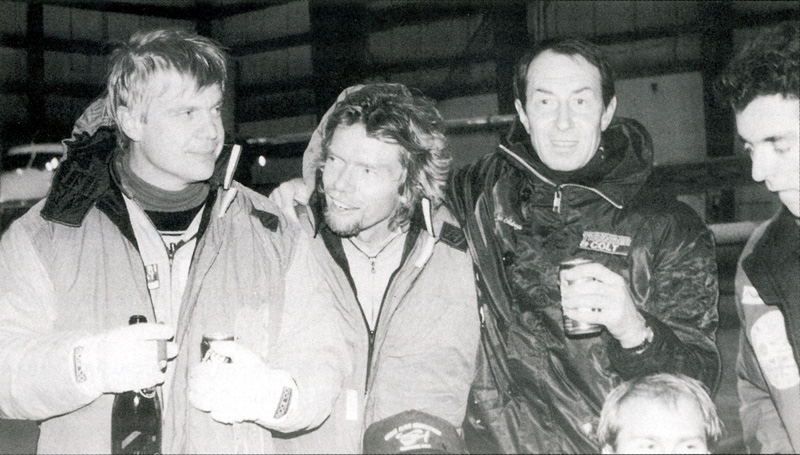
The bright yellow Cessna Cheyenne, twin turbo prop chartered from Ptarmigan Airlines in Yellowknife was waiting at Fort Simpson when Per and Richard landed. Jules and Jim Dirker were with it ready to transfer them back to the waiting team, families and media at Yellowknife, 230 miles away. About the same time. the group from the first helicopter returned from Rae-Edzo to learn the good news and join the reception party.
At 7 p.m., in total darkness, the Cheyenne returned to Yellowknife and taxied over to the Echo Bay Hangar and their reception. Instead of a huge press gathering, it was rather a personal homecom- ing, with greetings from Per's wife Helene, Richard's parents, Ted and Eve, and the support team. The world press was occupied with the new war thousands of miles from this little frontier town. To the local press and populace however, it was a "bolt from the blue" even making the front page of the "Yellowknifer"!
Despite: 3 hours of pre-launch checks
46 hours of concentrated flying
5 hours waiting to be rescued
4 hours flight back to Yellowknife
the duo were in good spirits, laughing and joking with the reception party and with good reason.
They had broken all the ultimate ballooning records, including:
- first hot air crossing of the Pacific
- longest manned balloon flight ever
- fastest manned balloon flight ever
Success for the pilots and team that shared their glory was celebrated with a dinner in, aptly, the Explorer Hotel. That night the pilots and their team had their first night's sleep for a long time.
FLIGHT RECORDS
The Pacific Flyer had broken the ultimate records for any manned balloon journey, flying faster and further than ever before with enough fuel left to have reached the North Pole!
The records included:
- —the first hot air balloon across the Pacific
- —the fastest manned balloon flight
- —the longest manned balloon flight
The amazing facts were:
- Balloon type — Thunder and Colt 2500 Reg No. — G.OWFF
- Take off — Miyakonojo, Japan Ref: 31043.53N, 130006.00E Time: Jan. 15th, 1991 - 18.47' UTC Jan. 16th, 1991 - 03.47' Local
- Landing — Northwest Territories, Canada Ref: 64025.14N, 120023.00W Time: Jan. 17th, 1991 - 16-53' UTC 09.53' Local
- Flight duration — 46 hours, 06 minutes (46.10 hr.)
- Distance — 6761 miles (5871 n.m. 10880 Km)
- Average speed — 146.66 mph (127.36 knots, 236.02 Km)
- Peak speed — 239.62 mph (208 knots, 385.4 Km/hr)
- Mean Cruise Altitude — 27,000 feet (8.23 Km)
- Max. Altitude — 36,000 feet (10.97 Km)
- Fuel burnt — 2526 Kg
- Consumption — 54.80 Kg/hr
NOTE: Results subject to FAI approval
Next Page


